Showing posts with label benefits of dance. Show all posts

Monday, November 18, 2013

Dancing: It's the Gift of a Lifetime


Stanley McCalla is a US Ten Dance Finalist, Fred Astaire National Smooth Champion, FADS National Dance Board Member, & National Coach and Adjudicator.


Dear Readers,

A few months ago on a Saturday night, I visited a salsa club in my area known for its sizzling Latin music and electric atmosphere.

After sitting down with a drink, I found my attention drawn toward a dancing couple that was executing some rhythmic moves and interesting turns.  They were musically fluid and their rhythm was catching.  They used intricate steps that were well blended together, and a nice communicative dynamic transpired through these two individuals.

Then I realized that they were using some steps taught at our studios, and they were technically quite efficient. I was still trying to figure them out when all of a sudden, they spun in my direction, looked toward me, and smiled.  I suddenly recognized them. 

Mark and Jenny were students at my studio, and a year ago, I had the privilege to coach them. I was very happy to see them together dancing so well and exuding so much harmony and fun on the dance floor.

The song ended and, as he shook my hand vigorously, Mark told me that taking lessons at Fred Astaire Dance Studios was one of the best investments that he ever made. Jenny added this (and I quote) —all because of our dancing the quality of our entire lifestyle has changed for the better, and we love it! Thank you so much!—(unquote).

That encounter certainly made my night! In fact, it made my week!

I had the feeling then that these people 'had it made,' too—that Fred Astaire Dance Studios had impacted their lives in really powerful ways, and that is—it really is—exactly what our studio and all the Fred Astaire Dance studios in the nation are about: to make a difference in people lives by teaching them how to dance. It sounds simple, and it is, but what an incredibly positive change it makes!

If everyone danced, we would all bring the world to a happier and healthier state of being, literally one step at a time. So, I think it is really important to pass on the message of dance. It's the gift of a lifetime.

If you know a friend or a loved one that could use a lift, a new social direction, more exercise, or a great place to belong, think about directing them our way. Your gesture might just be the push they need to bring them into a life that is filled with fun, friends, music, and dance.  

What could be better?

I'm raising my hat to you and to your future dancing friends --

Stanley McCalla
Dance Director, Fred Astaire Dance Studio Mamaroneck


Friday, November 15, 2013

"I Never Would Have Believed!": A Student Reflects on His NDC Experience


L to R: Yasmeen Sahira, Pro, Dave Forecki, and Dajana Stanic, Pro
  
Fred Astaire Dance Studios of Greenfield, WI, would like to thank Dave Forecki for representing the studio so well at his first National Comp! Dave made the Greenfield studio extremely proud when he won the Top Bronze Showcase Male award with his number, “I Wanna Be Evil”. What a great job, Dave!! 

“There are experiences that remain forever in your memory, says Dave. "After receiving a free dance lesson to Fred Astaire Studio from a wedding expo which I attended with my son and his fiancĂ©e a year and a half ago, I never would have believed I would be competing at a National Dance Competition, much less winning ‘Top Bronze Showcase Male’. 

"The grandeur and splendor I viewed, the grace and talent I observed, the comradery and support I received from the instructors and students from my region and the confidence I developed are some tangibles I experienced at the NDC in Orlando which will be the impetus for me to become a better dancer. It is an experience that is truly life shaping. As one of my instructors said, it's like a regional competition —on steroids!” 


Dave performed at  NDC with Greenfield Pros Yasmeen Sahira (to Dave's right)
and May Lee (to his left). The trio is shown here with Luann Pulliam
 and Joe Trovato

Thursday, November 07, 2013

Finding harmony in life through 'good moves'

Rae Josephs
The benefits of dance are well-documented: it's great for one's health; a fun social activity and a great confidence booster, as well as a skill that stays with someone forever.

In a recent article in Quintessential Barrington, Rae Josephs, Area Director of Fred Astaire Dance Studios in Illinois argues that dance supports long term good health through "the zen of mind and body together, along with a support team filled with encouragement," which can be found in a good dance studio.

Depending on one's perspective, life is short and the way one chooses to fill that time makes all the difference  — good or bad. 

Josephs  prescribes a "40-minute solution" of two to three dance sessions a week (40-minutes each) to achieve the ultimate goal of "full improvement, body and mind" through the benefits of dance. It's a fact that this closeness of lessons can change one's lifestyle for the better — part of the 'good moves' for enriching one's life.

Monday, July 29, 2013

What Oz Should Have Told the Cowardly Lion

There's No Place Like Fred Astaire Dance Studios, There's No Place Like . . . 

The Confidence to Compete 

Confidence. Everyone wants it; too many of us still seek it. Millions of self-help books promise it by the bucket load. It's a particularly desirable personal quality to have when facing a major life-change, like 16-year-old Riley Scott who's about to start college far from home. But, despite her academic success, Riley never found such personal strength in books. Instead, she gained it by ballroom dancing.

Riley is a Troy, Michigan native who is about to transition to her new college life in upstate New York. Like many young people in her position, she found it all a bit scary. And, like other academic students, Riley has a long-standing love affair with the printed word. But when it comes to developing real confidence, "dump the self-help books," she'd advise. And don't bother with a wizard. Instead, go to a Fred Astaire Dance Studio and take some dance lessons!

A recent article in the Bloomfield Patch summarizes Riley's experience at Evan Mountain's Bloomfield Hills, Michigan, Fred Astaire Dance Studio. Through ballroom dance, and the personalized guidance of her teacher, Mike Fonseca, Riley traded in her old, more-timid life for one filled with courage. (Oh - and the photos here are of the real Riley Scott. The Patch's video shows Fonseca teaching Barbara Benzos to dance because before the article was finished, Riley spread her new, confident wings and flew to greater heights!)

Great job, Mike, and all the best to our good friend Riley! Here's Boosting Confidence Through Dance at Fred Astaire.' 


Lessons Make It Possible

"I'm more comfortable being myself," says Riley.

Thursday, October 18, 2012

Bringing Brighter, Better Days: Westwood's Autism Workshop Spotlights the Incredible Benefits of Dance


by Nancy LaPierre


Author-therapist Victoria Marin, who features her autistic son in her popular children’s book, Aiden’s Waltz, brought her Waltz For Wellness workshop to the Westwood Fred Astaire Dance Studio on Saturday, October 13, to shed light on the benefits of ballroom dance for those on the autism spectrum.

Ms. Marin’s presentation teaches teachers, participants, and their caregivers about the healing powers of ballroom dance to relieve autistic symptoms, transform related behaviors, and bring about improved physical condition, better social skills and a much brighter outlook on life.

Jaclyn Laurino, a Westwood FADS professional dance teacher,  teaches Bryan to dance
 
‘Timothy,’ a 20-year old workshop participant, had never tried ballroom dancing before. He seemed nervous at first, telling his mother he wanted to go back home. But after the presentation, he asked to join the dance teacher on the dance floor. Immediately, his demeanor and postured changed. His rounded-shoulder stance changed. He stood upright. He was smiling —even giddy at times. With tactile prompting from his instructor, he learned the basic steps of the waltz within minutes. 

Ballroom dance helps strengthen the core, leading to better posture. This reduces pressure on the lungs and improves breathing and oxygen levels for people who spend time in wheelchairs. A strong core and strong shoulder girdle make fine motor movements easier so eating and handwriting skills improve. Muscle conditioning develops coordination and balance for walking, running, dressing, and enjoying leisure and sports activities.

And there’s more:

  • communication — partners engage in eye contact, invite their partners to the dance floor and discuss the dance process
  • friendships — dancers develop and nurture a trusting relationship with their partners
  • self-confidence — we teach dance steps in the method that is best suited to autistic learners. Mastering steps and movements leads dancers to feelings of success and accomplishment
  • mental processing — ballroom dancing to classical music opens brain pathways and improves mental organization and learning

Ms. Marin’s informative one-hour workshop includes a PowerPoint presentation and a 15-minute dance lesson for participants. To schedule a workshop, please contact her at (845)200-4101, or via email at aidenswaltz@gmail.com.

Wednesday, July 11, 2012

Ballroom Dance: Powerful Steps Beyond Autism


~by Nancy LaPierre

(Adapted from the letter ‘He Danced His Way from Disability to Ability’ by Victoria Marin)

“Ballroom dancing proved to be the ideal activity for my child.  It provided the opportunity to develop social and communication skills as well as more fluid and coordinated movements . . . . . a sense of self awareness as well as self esteem.” ~ Victoria Marin, mother of Aiden and author of Aiden’s Waltz

Autism rates have shot up 78% in the last decade, announces CNN’s headline, a disturbing footnote to March’s report by the Center for Disease Control and Prevention that 1 of every 88 American children is now affected by the disorder.  

Therefore, Victoria Marin, a dedicated Fred Astaire dance student at the Westwood, New Jersey studio, couldn’t have picked a better time to write her book, Aiden’s Waltz. At once a sensitive and inspiring children’s story and a tribute to our field,  Marin’s words testify to the power of ballroom dance to free her own son from many of the physical, emotional and social challenges of his disability. 

Marin, who holds a degree in Occupational Therapy and is the mother of five children, published this chronicle of her “out of the box approach to raising a child with special needs” in February this year. “These misunderstood children have suffered from difficulty in making friends and handling relationships with peers,” she wrote in her recent letter to us. Aiden’s mother is amazed by just how far her son has come through his dancing journey.  From a boy who used to do nothing but watch as other children played soccer, she reports, “Aiden rose from the shackles of autism to dance with the grace and elegance of a swan across the ballroom dance floor.”

Marin is convinced of the benefits of ballroom dance, especially when it comes to helping kids like Aiden, who are, her book teaches, “like every other child who needs love, care and respect.”  She credits ballroom dance with “a holistic approach to dealing with the challenges of autism,” and attests that the benefits to Aiden have been multi-dimensional and inspiring, reflecting physical, social, emotional and cognitive growth.

Prior to his dance lessons, she says, Aiden, like other autistic children, experienced great difficulty with recreational activities, such as being on a sports team and any other situations where initiating and maintaining peer relationships is necessary.  However, through dance, “my son’s communication skills developed to where he could initiate a conversation with his dance partner.  After continued participation, his communication skills blossomed to where he could approach other dancers and ask them to dance.”
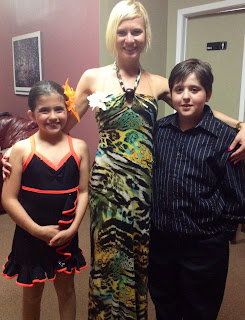
FADS instructor, Larisa with Aiden and his sister, Laura

Autistic students gain confidence in themselves and others through ballroom dance, for it requires that “the child learns to let go of their fears and anxieties and trust the movements of their partner,” Marin explains.  The constant contact with a partner it demands also helps overcome the distrust of physical closeness that often comes with autism. “In addition to learning the steps,” she explains, “dancing requires the participants to respect physical boundaries, maintain position and posturing and conform to the social rules of the ballroom,” all lessons that strengthen areas of weakness most autistic children face.

“Another fascinating component to ballroom dancing is the classical music,” she reports.  “New research has noted the role of music in facilitating self-expression, creativity and sociability in children.  Classical music appears to reduce stress while increasing the ability to concentrate.  Muscle tone relaxes and the heart rate slows which causes the mind to be receptive to learning.  A positive outlook or increased self esteem often leads to improvements in the creative thinking process.” And, she adds, the effect classical music has on the anatomy of the ear actually “stimulates brain activity.”

“The dance can be viewed as a dynamic conversation between partners where eye contact is necessary, external sensory stimuli is processed, gross and fine motor movements are coordinated and a relationship between partners is developed,” says Marin. To her great joy, Aiden overcame the seemingly-insurmountable hurdles autism erects in each of these areas through learning ballroom dance.

“In my experience, ballroom dancing helped my son to emerge as a young boy who no longer felt ‘different’ from the other children.  The world of ballroom dancing opened the door to a fresh and innovative sport.  Aiden beamed with self confidence which he gained from being a leading partner on the dance floor.  In time, his coordination improved which helped build his self esteem.” 

“While Aiden still is not considered a social butterfly,” she adds, “his beautiful ocean blue eyes look right at you when he speaks,” a directness that autism usually inhibits. “Ballroom dancing provided the necessary tools for my son to emerge from his own darkness and dance before the entire student body.”

Marin’s experience has made her faith in ballroom dance unshakeable:   “Given the support and opportunities,” she now knows, “all individuals with special needs possess talents as well as the ability to achieve!”

Thank you to Renata Sowul, Manager at FADS Westwood, N.J., for introducing us to Aiden, Ms. Marin, and her book.  Ms. Marin and two of her children are warmly welcomed students of Renata’s studio.